The Parable of the Obi of Ogwashi Ukwu and the Farmer’s Daughter
Now, I have ventured to Nigeria on several occasions, all but a few for business reasons...
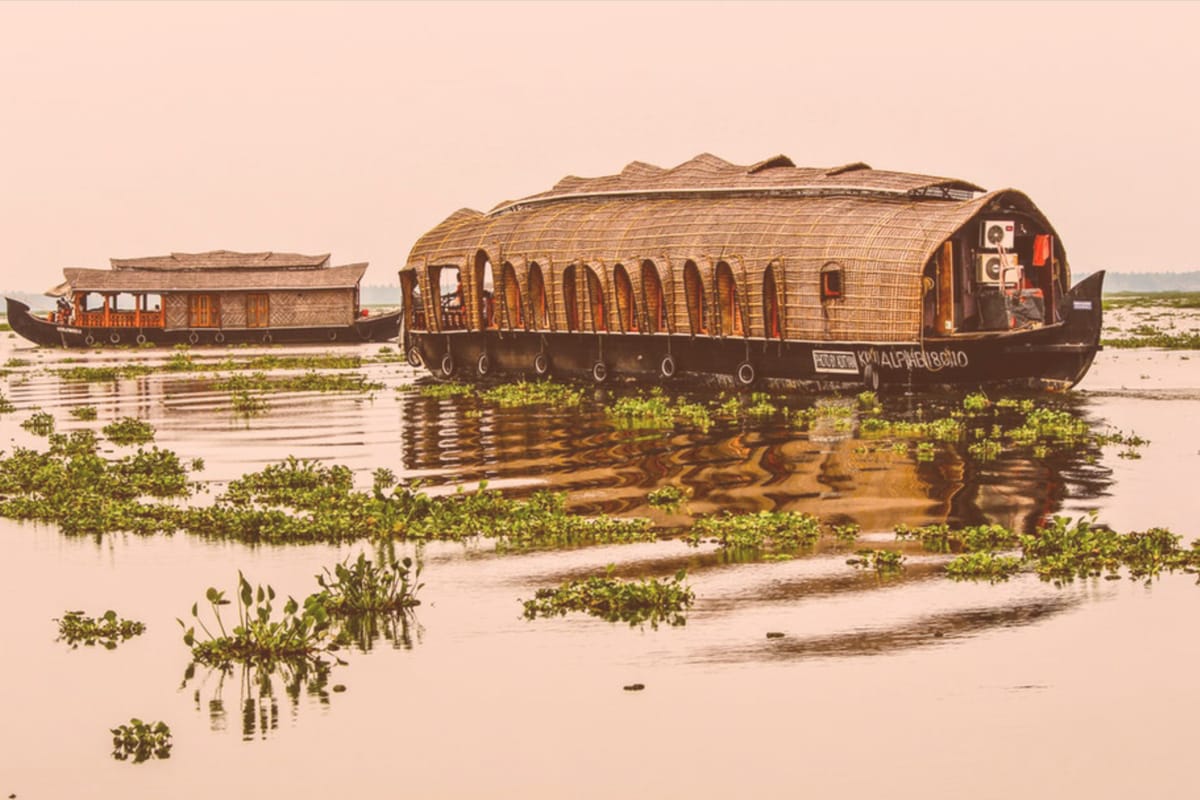
Now, I have ventured to Nigeria on several occasions, all but a few for business reasons. It was during one of my decidedly pleasurable jaunts through the coastal regions of Koko and Burutu that I met an expatriate Canadian lawman who had traded in his loyal steed for a truck and a houseboat. It had long been a dream of mine to float my way up the river Niger, and so after some rather skillful bartering on my part, I was able to arrange the exchange of my large vehicle and the services of my Man Olaudah, a faithful but homesick Igbo, to the wayward Mountie. Coincidentally, he was trying to reach the very town where Olaudah’s dear mother had taken sick and now spent her days convalescing under the care of her husband’s other wives. I received in return the truck and the houseboat, both well stocked with fuel and supplies.
Upon arriving at the shore of the Niger, I sold the truck to a hammock merchant in need of a more suitable means of transporting goods to market than the backs of his three daughters. I replenished my food stores in the market, while a smiling, toothless fisherman scrawled a rudimentary chart of the river for me on a scrap of skin, amid puffs on his tar-stained tobacco pipe. I was fortunate enough to collect a few records and even some books to keep me company on the journey ahead. A young boy took to following me through the market, hoping to sell me one of his little bags of puffed-maize, despite one or two stones flung in his direction. The longer I observed him, I grew to find his personality so winning that in the end I bought every bag he had. Then he insisted on helping me load my supplies onto the houseboat, and when I finally agreed, he proved a harder worker than half the grown men on the docks, jumping into action with all his might, gleaming with sweat, his shirt tied around his waist. He said his name was Ejura ma'jadu ubie, and he swore it wasn't a girl's name. I told him I might return this way, and he made me vow to stay at his home and not in one of the hostels, where he swore I was certain to be robbed.
In good spirits, I embarked on my journey along the Niger which, I’m sorry to say, was doomed from the start. After only a few days I realized that damnable lad Ejura had lifted half my coin. In a rage, I dumped his puffed-maize overboard, but that only served to attract a school of large fish who immediately gummed up the boat's propulsion. Twice while diving to make repairs, I was forced to rush aboard, fleeing crocodiles attracted by the gore. Not a day after setting off again, in a particularly nasty and highly unseasonable tropical storm, my craft ran aground to great ruin in an area that as far as I am aware is entirely unpopulated, save by a handful of distasteful insects. I waited out the storm, which lasted a fortnight and three days beside in what remained of the houseboat, forcing down the last of my nearly-spoiled rations. When the food ran out, I was compelled to survive on the insects which were in no short supply as they scrambled for shelter from the flood. Many insects make for delicious treats, even delicacies when properly prepared. These ones, however, raw and wriggling, were among the most disgusting things I've had the misfortune of consuming. I might have tried drying them, but the storm was so fierce I couldn't even spark a fire.
At last the rain let up. I began to wind my tedious way North, and West, as best as I could tell, surviving on the few scrawny and malnourished creatures that were so unlucky as to stumble into my primitive snares. All of a sudden I came upon the splendid, stately - and certainly quite welcome given the circumstances - estate of none other than the Obi of Ogwashi Ukwu. I hadn't seen the place as I approached, for it sat quite hidden below a sharp ridge in the surrounding terrain, encircled by spiny acacia, and I nearly tumbled into the Obi's cook-fire when I stumbled over the edge.
I was welcomed heartily, for the Obi had heard of me. As chance would have it he had, in fact, dispatched a note requesting the honor of my council not a week past to my summer home in the Alps, where I was rumored to be living at the time. Naturally, the Obi was quite surprised that I had arrived so quickly, considering the note had probably not yet found its way out of the country. He was nonetheless pleased to escape straining his royal patience in anticipation of my input on the matter in question. He threw a celebration, apologizing that it paled in comparison to the spectacle he had planned for my arrival, given such short notice. I assured him I would be thrilled with just about any nourishment that wasn’t still twitching, and soon my stomach was dangerously full.
At last, when all the formalities had been observed, the Obi and I retired to a pleasant earthen patio deeper within his sprawling estate, and he began to relate to me the reason he required my assistance. There lived a farmer nearby who, having been entrusted with a plot of the Obi’s land, had done quite well for himself. In truth, he seemed to have a way with growing crops which made mere green thumbs look sadly devoid of virescent majesty by comparison.
Now, he kept the local markets well-stocked with his fine foodstuffs, and gradually his household grew similarly well-stocked with wives. Those wives, being well above mere stock allure, and themselves of noble stock, bore the farmer a hearty stock of gentle daughters, all now come of age and held in high stock among the local bachelors. I took a sip of chicken stock and glanced at a nearby guard, leaning on the stock of his repeater. The farmer now regularly enjoyed the company of more beautiful women than the Obi. Naturally, the Obi decided it was time he took another wife. He had taken stock of the local stockpile of potential brides and found himself infatuated with the farmer’s youngest and decidedly most beautiful daughter, Amaka.
The farmer, questioning the Obi’s intentions, grew suspicious, as any good father would, I suppose, given similar circumstances. He wondered I’m sure whether the Obi was simply acting out of pleonexia, or if he was solely interested in her as a sexual conquest. Perhaps he wished to force a sort of suppressive alliance, ere the farmer’s assets surpassed his own. Whatever the farmer thought, he apparently wasn’t pleased, because he refused to give his daughter to the Obi - a situation that the Obi found most vexing. But what was he to do? This is the matter on which the Obi had sought my counsel.
Initially, the Obi expressed concerns about the possibility an unfortunate accident might lead to the farmer's untimely demise, given the dangers of living in such a rough and remote province. To the contrary, I explained such incidents were not only discouragingly costly but also woefully prone to oversight. Too often I’ve seen the unexpected abruptly crop up and ruin the most admirably planned assassinations. Not to mention dear Amaka might understandably be somewhat disinclined to toddle into the arms of the nearest eligible regent in the devastating wake of her father’s demise. Of course, there is the chance that in her vulnerability and pain she might reach out and blindly grasp the Obi’s offer of stability and love, but then consider: living with a woebegone woman, always glum and doleful, inconsolable, complaining about the loss of her paternal paterfamilias. In my experience, it is just that sort of thing that makes a once lovely woman decay into a cheerless shrew and reduces a once happy man into an irritable curmudgeon. Furthermore, though surely his majesty is above such raw sentiments as guilt or remorse, a lesser man might suffer considerable anxiety faced with constant reminders of the pain brought about by his ambition.
No, the Obi agreed, a murder would simply not do. Something more crafty, then, and with less collateral. A story I once heard came to mind, of a homely man who offered ten cattle for a wife who, to look at her, couldn’t have been worth more than a goat or two. It was said that her husband’s act of lavish magnanimity imbued the girl with such a sense of self-regard that to this day she is rumored to be the most beautiful woman you could care to meet. This tale was met with some skepticism on the Obi’s part, and he made the case that Amaka already possessed such a stunning pulchritude that any gift worthy of her hand was unlikely to improve upon it. An offering costly enough to be considered lavish for a woman of her rare attraction would undoubtedly have an adverse effect on the precarious balance of familial power, as it were, between the Obi and the farmer. It was clear that generosity was out.
Of course, the Obi rejected outright the suggestion that he might use the wedding as a means to combine the two families in a powerful ruling dynasty, simply out of cupidity. It was at this point that an alternate approach came to me. I have picked up, in my travels, a few select abilities here and there. When I observe someone doing something I cannot readily explain, I often make it my goal to ascertain their methods. It was such a situation that lead to my assimilation of the technique of hypnosis. I put forward the idea that I might avail myself of that aptitude, and sway the farmer’s family to favor the Obi’s fancy. This idea appealed to the Obi, for surely if it went wrong, the blame could only fall on me, an interloper. So it was we formulated the means by which I might infiltrate the farmer’s clan.
As luck would have it, a few days later, Amaka found me staggering out of the bush, my clothes a shambles, and my hair strewn with sticks and leaves. She caught me up in her sinuous arms just as I collapsed in a heap, apparently from exposure and exhaustion. With a show of great effort, I pried my eyes open, only to have them ensnared by her own bewitching, smoky gray eyes, as she peered down at me in concern. Smoothing a stray strand of hair from across my face, she promised to nurse me until I was restored. The farmer and his wives nurtured me back to health over the next few weeks, which, as it turned out, was precisely what I needed after my incident on the river. Each day Amaka took it upon herself to keep me company, overseeing my recovery with fierce devotion. Her conversation was unendingly welcome, and she seemed to enjoy my presence as much as I enjoyed hers, which was nothing short of thrilling.
One day as we strolled along near the cook-house, discussing theoretical physics, the farmer approached. Taking me aside, he disclosed his suspicions regarding the Obi’s devious intentions. Like the farmer, I was taken aback by the impudent monarch’s audacity. I promptly suggested that given my extensive experience in dealing with such typical royal skullduggery, I might approach the Obi as an envoy for the farmer. Being a wise and reasonable man, the farmer accepted appreciatively. He sincerely expressed that I would surely merit his bountiful gratitude should I alleviate the matter.
I left at once and went straightaway to the Obi’s estate, where I was quickly ushered into an audience with the impatient ruler. He seemed a bit on edge, and somewhat agitated, but on assuring him that the process was proceeding better than planned, he fell into wary relief. "These things take time, Your Grace," I explained. "Perhaps I might aid you in a bit of deep relaxation, to take your mind off things, and settle your nerves."
Hypnosis, contrary to popular misconception, is simply a state of heightened openness to suggestion. In some cases, the subject lacks the world-view - the attitudes and beliefs - that make the process productive. In these cases, hypnosis in the short term is almost entirely ineffective. In other cases, the individual readily offers up their mind and drifts easily into that state of diminished peripheral awareness, where, focused solely on the practitioner's voice, an immediate result can be achieved.
...like wangling candy from a baby...
The Obi was a man content as a friar in a winery. So pleased was he with my counsel, and so agreeable his mood, that in an uncharacteristic act of altruism, he donated the full measure of his wealth and estate to the farmer’s dynasty. What's more, he resigned his title as Obi and left at once on a journey seeking enlightenment in parts unknown. This turn of events so pleased the farmer, who was uncontested in his claim to the throne of Ogwashi Ukwu, that on the day of his ascension, he promised me any gift, up to half his kingdom. Now I am not a man to disregard an opportunity when it arises. Often one hears silly tales of men turning down such generosity in favor of some alternative of supposed higher moral piety. I am of the humble opinion that a little pecuniary recompense never stood in the way a lesson well-learned. In other words, I think you can eat a hearty dinner and still have an appetite for dessert.
Happily, Amaka was more than pleased to accept my proposal, and the rest, as they say, is history.
“But wait,” you say, “this tale is a parable, and as such, it must have a moral!” Well, in that you are correct, my fine reader. Amaka returned with me to my Alpine summer home, where she has begun pursuing her lifelong dream of becoming a painter. Her batiks are quite pleasing to the eye, and the marriage of her vibrant African style with the standard local movements has been filling a unique void in the European artistic milieu, and in turn, topping off our brimming coffers. I finally received the Obi's letter of invitation not long after we arrived, and had it framed. It is hanging on the wall of my study, next to a lovely portrait Amaka painted of Ejura ma'jadu ubie the last time we stayed with his family. And so I suppose you could say that the moral of this story must certainly be... good heavens! Is that a flaming rickshaw? What the devil is a rickshaw doing in the Alps? Please excuse me... Amaka, darling, are you seeing this?